Description and research notes
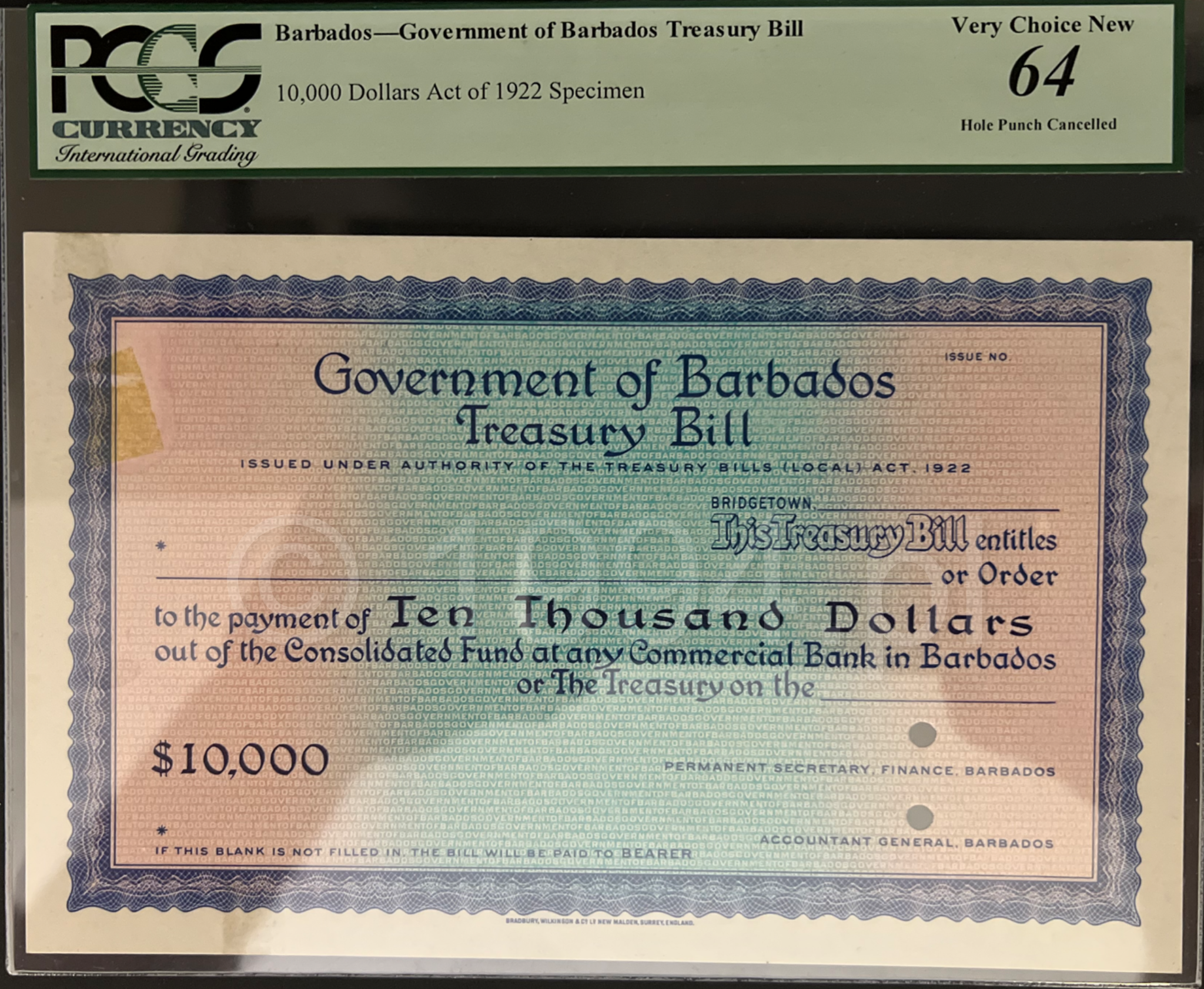
This Treasury Bill specimen was issued by the Government of Barbados under the authority of the Treasury Bills (Local) Act of 1922 and represents a non-circulating fiscal instrument prepared for internal treasury reference and archival retention. The denomination of ten thousand dollars reflects a high-value obligation within the Barbados Treasury Bill structure, intended for significant accounting and liquidity operations rather than routine fiscal use.
The note is printed in a refined multicolour engraved security design, framed by an ornate guilloche border and filled with a dense repeating “Government of Barbados” underprint across the entire face. The denomination “$10,000” is prominently printed at lower left, while the central obligation text sets out payment terms under the authority of the Treasury Bills (Local) Act.
The legal text establishes the bill as payable to order out of the Consolidated Fund at any commercial bank in Barbados or at the Treasury, reflecting the standardized obligation language adopted for Treasury Bills of this later period. The place of issue, Bridgetown, is incorporated into the printed layout, anchoring the instrument within the formal administrative framework of Barbados.
No prefix letter or serial number is present on the face of the bill. This configuration was used for selected specimen examples retained for reference and control rather than for issuance or financial circulation.
Cancellation has been applied by punch hole, permanently invalidating the document for payment or settlement while preserving it as an official specimen. The perforations are positioned in the lower portion of the note and form part of the controlled specimen handling process applied to Treasury Bills retained for reference rather than circulation.
This example is preserved in graded condition and represents a complete specimen state defined by denomination clarity, standardized legal wording, engraved security printing, and punch-hole cancellation. Surviving specimen Treasury Bills of this denomination are scarce and are typically encountered as isolated institutional remnants rather than as part of documented series.