Description and research notes
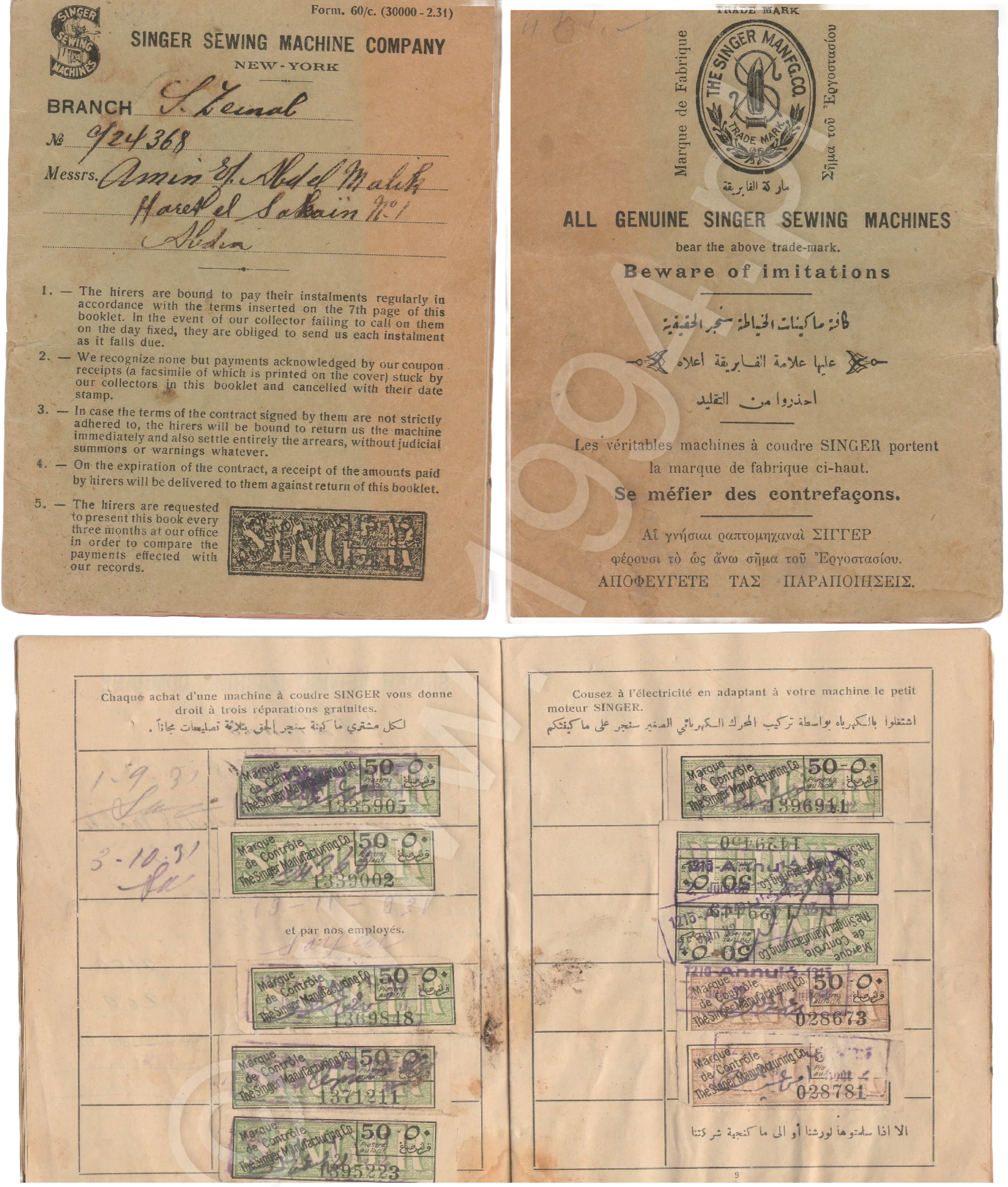
Original 1931 Singer Sewing Machine Company service and instalment booklet issued in Cairo, printed on tan card stock with the standard Singer Manufacturing Company masthead, including the New York parent company reference at top. The front cover shows the booklet form number 'Form. 60/c. (30000 - 2.31)' and a small Singer Sewing Machines trade-mark medallion at upper left. Branch name and contract number are filled in in large manuscript ink, along with the hirers’ names recorded in flowing early-20th-century Arabic and English script. The cover also includes the standard five-point printed conditions governing instalment payments, usage of collectors' receipts, and return of the machine upon default.
Interior pages contain pre-ruled instalment boxes, each originally intended to hold Singer’s proprietary fiscal adhesives. These are fully present: multiple green 50-mills 'Marque de Contrôle / The Singer Manufacturing Co.' revenue stamps, each with serial numbers and the bilingual French-Arabic inscription. Every stamp is tied with purple-violet dated cancellations, the majority reading 1931, with several entries also bearing manuscript dates in Arabic script (e.g., 1-9-31, 3-10-31). The stamps are affixed in neat rows, though some pages show traces of in-period handling—light smudges, small mounting abrasions, and faint ink offsetting around the centre fold.
The booklet also includes Singer’s multilingual advertising and authenticity pages. One page shows the iconic Singer oval trade mark with needle and shuttle, surrounded by text in English, French, Arabic and Greek warning customers to beware of counterfeit machines. Typography varies between serif, sans-serif and compressed styles characteristic of Singer’s international printing division in the 1920s–1930s. The paper tone transitions from light cream on the interior to a slightly darker, more textured card on the covers.
The binding remains original, with iron-staple oxidation visible along the central fold but no loss of paper. All pages remain attached. Ink colours, stamp placements, and manuscript additions align with known Cairo-branch Singer documentation practices, confirming the booklet’s full authenticity and continuous use throughout 1931.
By the early 20th century, the Singer Manufacturing Company had become one of the most widespread global enterprises in the world, with a sales and service network spanning Europe, Asia, Africa and the Middle East. Unlike most Western firms of the era, Singer operated through fully localised branches, employing multilingual staff and adapting its administrative paperwork to local legal, linguistic and fiscal requirements. Egypt was one of Singer’s most successful markets: sewing machines were essential household tools, and the company’s Cairo and Alexandria branches supplied homes, workshops, tailors, and textile traders throughout the country. Singer’s business model relied heavily on instalment purchasing, which made machines affordable to broad segments of society but also required strict payment tracking.
To manage instalment contracts, Singer created proprietary fiscal stamps that acted as both receipts and internal control marks. Each payment required the customer to appear at a branch or authorised collector, where a Singer-branded adhesive would be affixed and cancelled in the instalment booklet, creating an auditable sequence of payments. These stamps functioned as a private company’s version of revenue stamps and were used across many colonial and semi-colonial markets. Their design, multilingual inscriptions, and sequential numbering ensured that Singer’s global accounting was standardised from New York headquarters to local branches.
Multilingual printing in English, French, Arabic, and Greek reflects the cosmopolitan composition of interwar Cairo and the diverse clientele of Singer’s Egyptian operations. Few companies of the period produced commercial documents in so many languages simultaneously. The warning against counterfeit machines and the prominent trade-mark pages illustrate Singer’s efforts to protect its brand in regions where imitation machines were common. These pages also show the company’s reliance on printed educational material to maintain consumer trust in an era before electronic warranties or digital registration.
Most instalment booklets were discarded after repayment or destroyed during later household cleanouts. Others were stripped of their Singer fiscal adhesives by early collectors who valued the stamps but not the underlying documents. Complete booklets retaining the entire payment sequence, multilingual warnings, branch annotations, and tied proprietary stamps are rarely encountered.
Complete Singer instalment booklets with intact Singer-branded fiscal stamps, all tied with dated cancellations, are extremely rare. Most period booklets were discarded after machine repayment or stripped of stamps. This example preserves the entire fiscal sequence, full multilingual content, branch annotation, and the factory trademark pages, making it one of the finest surviving examples of Singer’s commercial and fiscal presence in Egypt during the interwar era.