Description and research notes
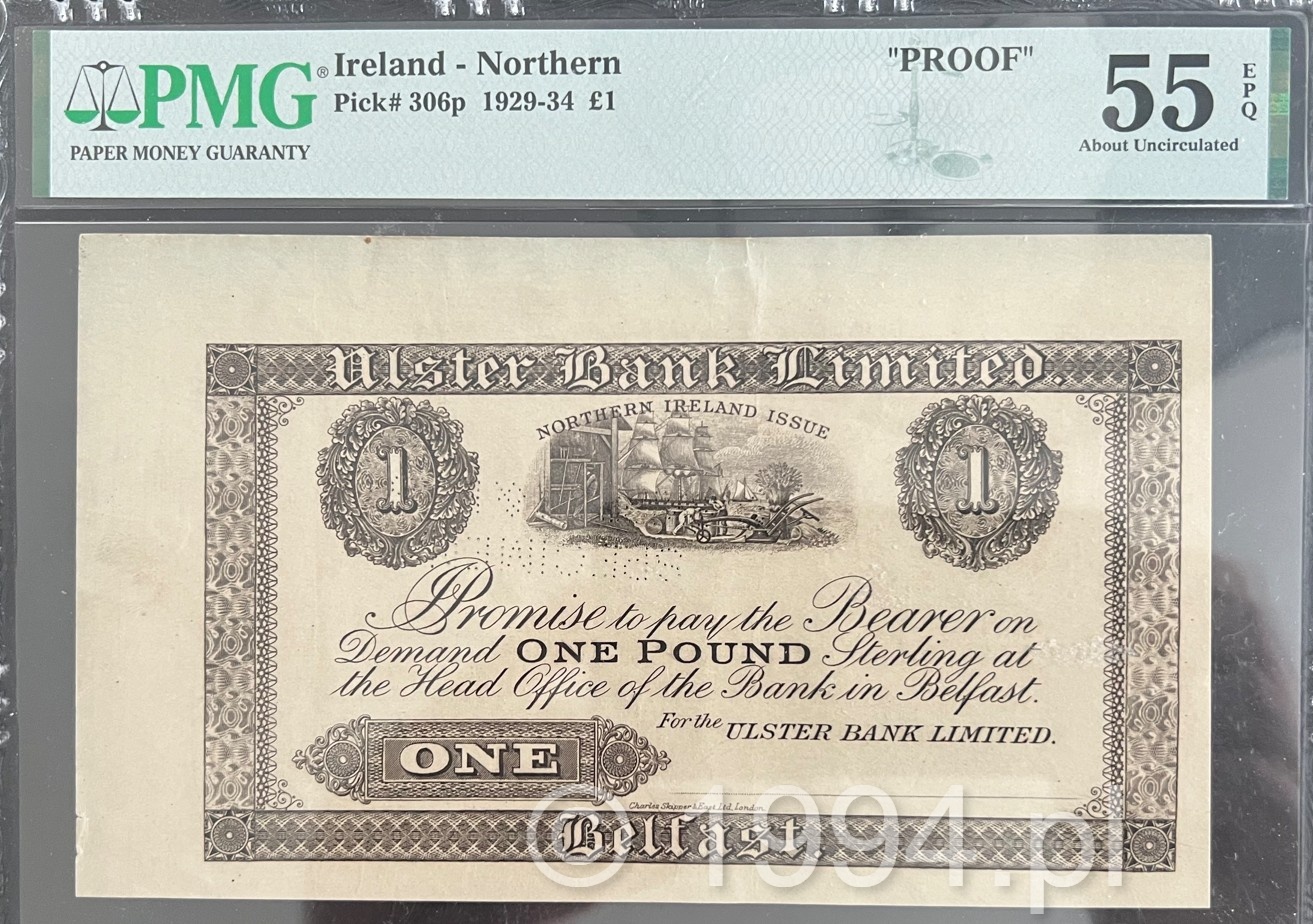
This 1929 Ulster Bank Limited 1 Pound proof belongs to the Northern Ireland Issue period, when commercial banks in Northern Ireland continued the older Irish and British private-bank note tradition under a sterling monetary system. The note is cataloged as Pick 306p and represents proof-stage material for an Ulster Bank Limited 1 Pound design prepared after partition, when Belfast had become the central geographic identity for the bank’s Northern Ireland note issue.
Unlike a state treasury or central-bank note, this design presents the obligation of a commercial bank. The face is built around the name Ulster Bank Limited, the promise-to-pay text, the Belfast place name, large denomination cartouches, and a maritime-industrial vignette that evokes commerce, shipping, and regional economic activity. The proof preserves that institutional language before the note entered ordinary issuing form, making it a document of private-bank monetary authority as much as a piece of security printing.
PMG identifies the piece as a proof, graded PMG 55 EPQ About Uncirculated, with specimen perforation and selvage included. The retained selvage gives the proof a sheet-context that is rarely preserved on a single note, while the specimen perforation marks the piece as controlled production material. These features keep the object close to the production and approval process rather than reducing it to a separated printed design.
The proof is printed on Ulster Bank Limited watermarked security paper, visible through the reverse under light. The watermark ties the paper itself to the issuing bank, adding a second layer of institutional identity beneath the engraved face. Together, the bank-name watermark, Belfast issue language, specimen perforation, and selvage show how private-bank paper money was physically constructed, controlled, and prepared for issue in the Northern Ireland banking system.
PMG records only one graded example for Pick 306p, and this PMG 55 EPQ About Uncirculated proof is that sole recorded example. Its population 1 status supports its classification as an R9 Extremely Rare proof survivor.