Description and research notes
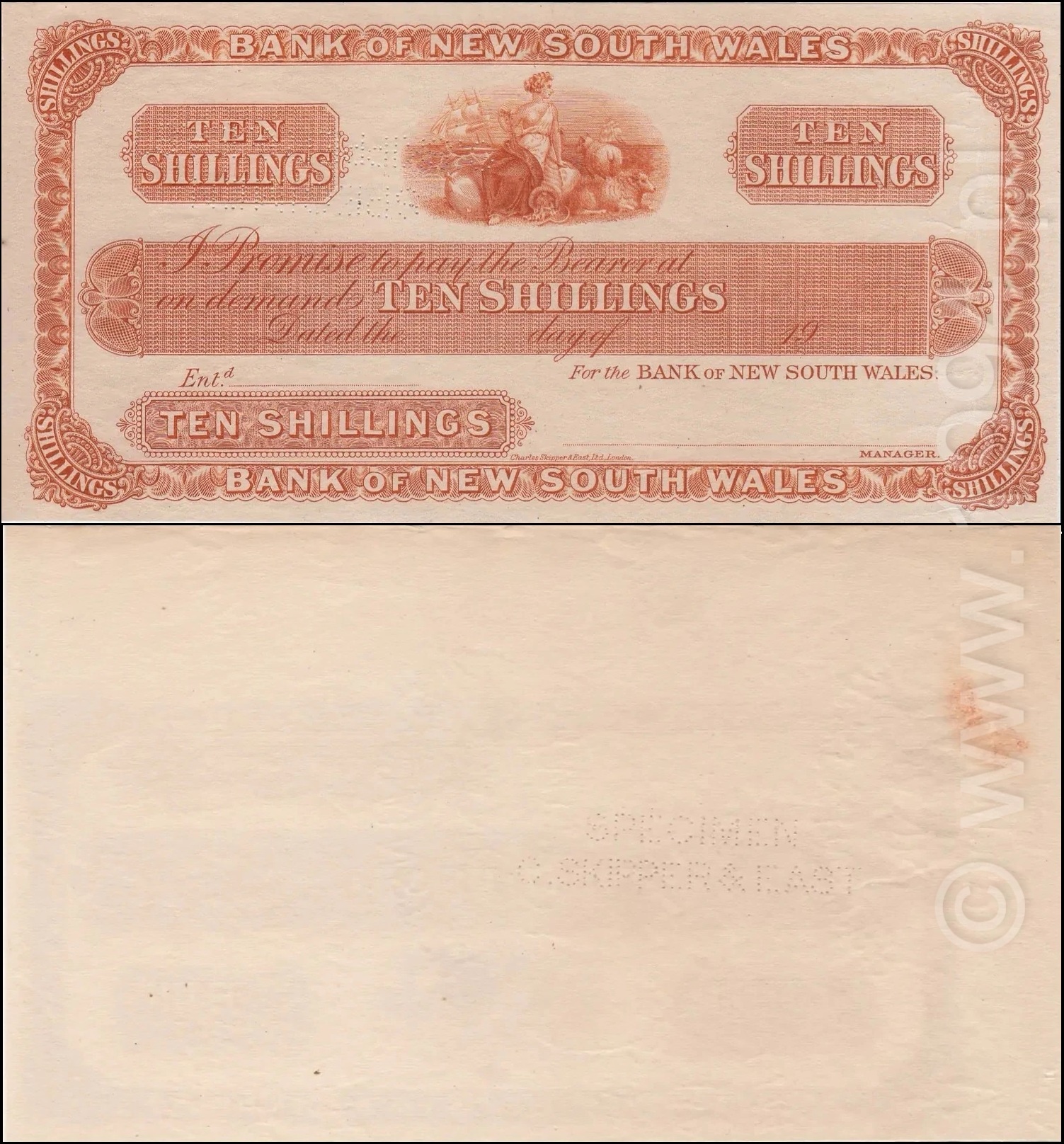
Printers archival proof for the Bank of New South Wales Ten Shillings, classified in the Standard Catalog and grading records as New Zealand Pick S161s (ND 1924-1933) and produced in London by Charles Skipper and East. This piece was never intended for circulation. It was created as part of the printers internal proofing, approval, and archival process and survives as a workshop original documenting the final approved design for a denomination that ultimately never entered public issue.
Although cataloged under New Zealand, this note must be understood within the broader Australasian operating structure of the Bank of New South Wales. The bank functioned as a trans Tasman institution, active in both Australia and New Zealand, and relied on London based security printers to supply unified design languages for use across multiple jurisdictions. Classification under New Zealand reflects later operational context rather than the geographic origin of engraving or printing, which remained firmly anchored in London.
The proof is printed single sided in orange red intaglio with a completely blank reverse and carries the perforated control legend SPECIMEN C SKIPPER AND EAST. This marking is formed through a fine matrix of pinhole perforations applied by the printer and serves as a control device identifying non circulating material. Such perforations were not cancellations and were not applied by issuing authorities. They were internal printer controls used to distinguish proofs and reference material from production stock.
The design itself exemplifies Skipper and East mature interwar engraving style. Ornamental guilloche frames, dense microlettering within the TEN SHILLINGS value panels, and balanced symmetry reflect London security printing conventions intended to convey institutional authority and trust. The central vignette combines maritime and pastoral imagery, showing an allegorical female figure with sheep in the foreground and a fully rigged sailing vessel behind. This imagery functions as a visual synthesis of agriculture, trade, and transport, representing the economic foundations of Australasian banking and commerce during the early twentieth century.
As an object, this proof documents a stage of banknote production that sits outside normal issue chronology. The ND 1924-1933 date range used by PMG and the Standard Catalog does not indicate a single year of printing. Instead, it reflects the period during which the Bank of New South Wales operated under this design lineage in New Zealand. Skipper and East routinely reused and adapted master steel plates over extended periods, modifying lettering, borders, and institutional references as banking charters evolved. Proofs such as this capture the printers finalized working model rather than a dated circulation release.
Technical diagnostics confirm its proof status. The intaglio inking is deep and even, with sharply resolved microtext and clean line junctions. The blank reverse confirms proof stock rather than issued paper. Light waviness in the paper surface is consistent with proofing and drying processes associated with single color intaglio pulls. The perforated SPECIMEN control marking, combined with the absence of serial numbers, prefixes, and signatures, places the note firmly within the printers proof and archival category.
Survival context is equally important. This design is not known in issued form, and no circulation notes exist for the 1924-1933 Ten Shillings under this lineage. All recorded examples are proofs bearing printer applied SPECIMEN markings. Certified population data indicates only a small surviving group, emphasizing that this proof does not represent a withdrawn issue but rather the only surviving manifestation of the design itself.
As a museum grade research artifact, this proof embodies several converging narratives. It illustrates London based contract engraving for colonial and dominion banks, the trans Tasman operational identity of the Bank of New South Wales, and the use of perforated control markings as an internal security and archival mechanism within early twentieth century banknote production. Rather than serving as a monetary instrument, this piece functions as documentary evidence of how colonial banking institutions planned, approved, and archived designs that in some cases never reached the public.