Description and research notes
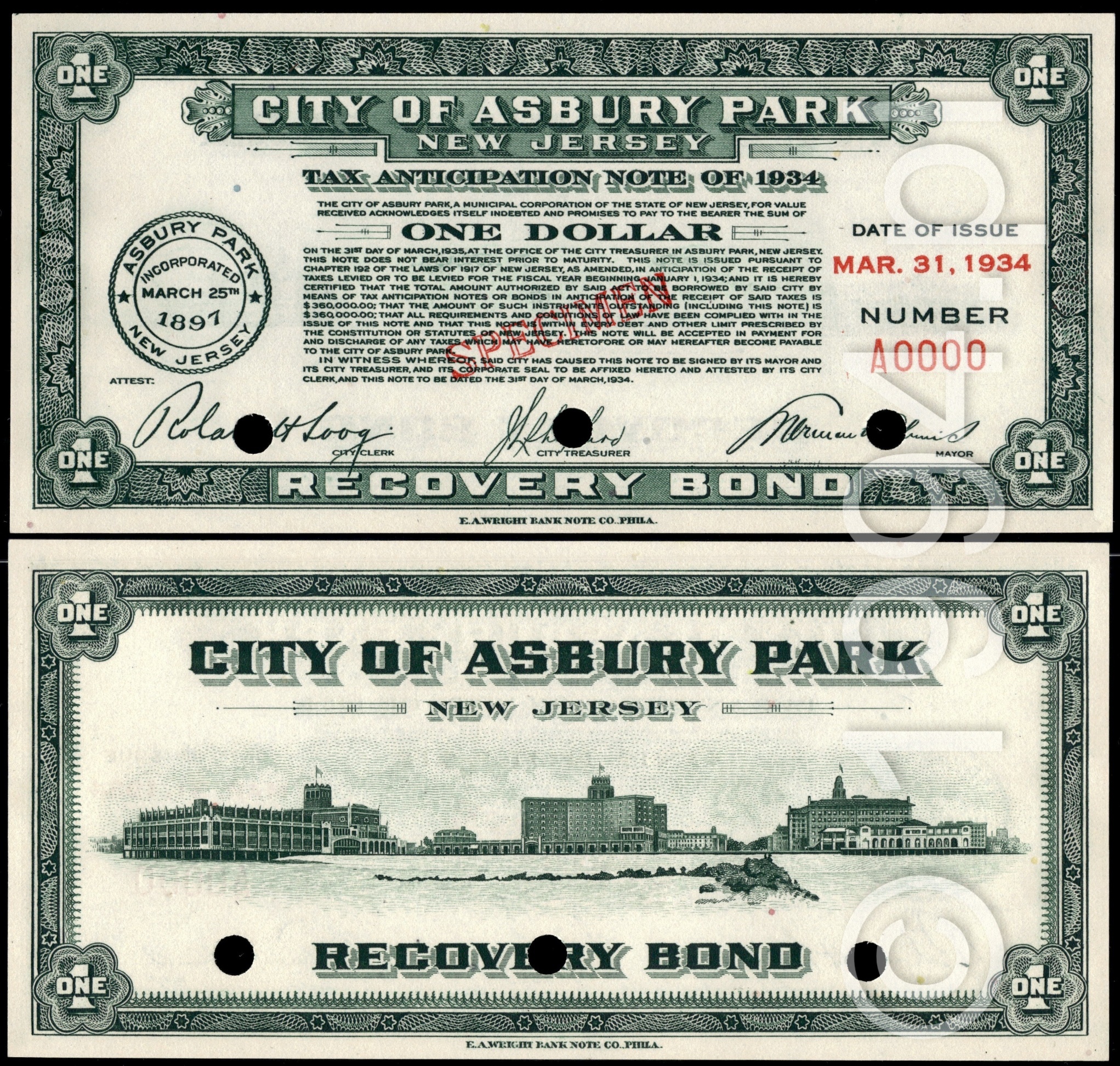
This specimen represents an official municipal tax anticipation note issued by the City of Asbury Park, New Jersey, dated March 31, 1934, and denominated One Dollar. Explicitly titled TAX ANTICIPATION NOTE OF 1934 and further identified on the design as a RECOVERY BOND, the instrument forms part of a structured municipal financing program implemented during the depth of the Great Depression, when local governments faced severe cash shortages and unstable revenue collection.
Tax anticipation notes were legally authorized short-term obligations designed to transform expected tax receipts into immediate operating funds. In early 1934, Asbury Park employed this mechanism to sustain daily municipal functions and preserve fiscal continuity while awaiting the collection of property and other local taxes. The issue was authorized pursuant to Chapter 192 of the Laws of 1917 of the State of New Jersey, as amended, placing it within an established statutory framework rather than emergency improvisation.
The engraved legal text states that the City of Asbury Park, a municipal corporation of the State of New Jersey, for value received acknowledges itself indebted and promises to pay to bearer the sum of One Dollar. The note was issued at the office of the City Treasurer and does not bear interest prior to maturity, consistent with its intended use as a rapidly redeemable anticipation instrument. It is expressly acceptable in payment for and discharge of any taxes thereafter payable to the city, reinforcing its dual function as both a municipal obligation and a fiscal settlement medium.
The text further certifies that the total amount authorized to be borrowed by the city through tax anticipation notes under the governing statute was three hundred sixty thousand dollars, and that the amount outstanding, including this issue, did not exceed that statutory limit. It also affirms compliance with constitutional and statutory debt restrictions, a reassurance of legal and financial discipline at a time when municipal defaults were widespread and public confidence fragile.
The obverse is executed in green engraved security printing by E. A. Wright Bank Note Company of Philadelphia, a prominent American printer of municipal and financial instruments. The design presents a formal civic layout with clear identification of the issuing city, denomination counters, and a large engraved corporate seal of Asbury Park. The serial number A0000 and the overprinted word SPECIMEN identify this example as a printer-issued specimen produced for authorization, approval, or archival reference rather than circulation.
The reverse carries an engraved panoramic vignette of the Asbury Park waterfront and boardwalk, visually anchoring the obligation to the city’s economic identity as a resort municipality particularly vulnerable to the collapse of tourism and discretionary spending during the Depression. The prominent appearance of the words RECOVERY BOND underscores the intent of the issue: to frame short-term municipal borrowing as part of an active recovery strategy rather than passive deficit financing.
Within the 1934 Asbury Park series, the One Dollar denomination represents the lowest value note, intended for everyday municipal transactions and small-scale tax settlements. Its existence alongside the Five and Ten Dollar denominations illustrates a graduated structure designed to facilitate broad public use and practical circulation within the local fiscal system.
Specimen examples of tax anticipation notes were produced in extremely limited numbers and were typically discarded once an issue was approved and operational. Unlike issued notes, which were redeemed, cancelled, and destroyed through routine fiscal processes, specimens had no functional role and survived only by chance.
No other specimen example of this City of Asbury Park One Dollar Tax Anticipation Note of 1934 is documented in institutional collections, auction records, certification census data, or standard reference literature. Based strictly on observed and recorded evidence, this piece stands as a unique surviving specimen and serves as a definitive documentary artifact of Depression-era municipal finance and recovery policy in the United States.