Collection PL

About
195 results · Page 1 of 17
Complete nine-note Stockholm Spinnhus pollett monetary system from circa 1785, including all denominations from one half öre to one daler, preserved in unissued condition and classified as R10 extremely rare.

Sweden 1785 — Stockholm Spinnhus Pollett System – Complete Nine-Denomination Institutional Currency Set (One Half Öre to One Daler)

This complete nine-note ensemble represents the entire internal monetary system of Stockholm’s Spinnhus, the women’s correctional institution and workhouse operating on Långholmen Island during the late eighteenth century. Produced circa 1785, these engraved pollett notes functioned as closed-economy institutional currency, issued exclusively for use within the prison environment. They served as a controlled medium of exchange through which inmates were compensated for labor, particularly the spinning and processing of flax and wool. ... Read more →

SwedenInstitutional Paper Currency Set1785Complete nine-note system: one half öre, one öre, two öre, five öre, six öre, seven öre, sixteen öre, twenty-four öre, one dalerUnissued Uncirculated with archival tape residue on several pieces PollettInstitutional paper currencyEngraved copperplate noteEighteenth century rag paperAnopisthographic printingUnissuedUncirculatedStockholm engravingSwedish copperplate productionPre-industrial note manufactureStockholm SpinnhusLångholmen prison economyPenal labor currencyClosed economy tenderProto-fiat institutional moneyInternal monetary systemSweden1785One half öreOne öreTwo öreFive öreSix öreSeven öreSixteen öreTwenty-four öreOne dalerFull denomination setPick UnlistedR10 UniqueR10UniqueUnique Known ExampleUnique Set
Unissued
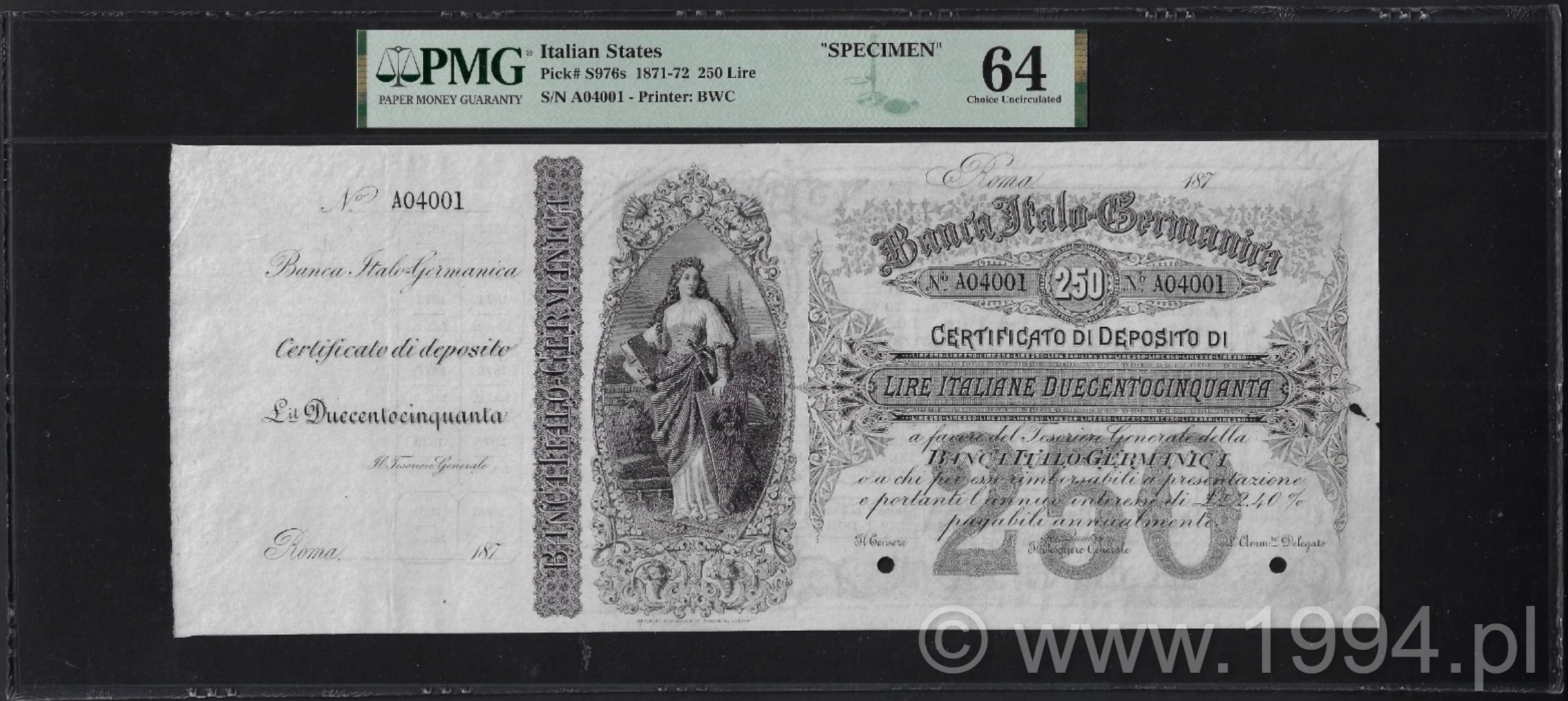
Italy 1871–1872 Banca Italo-Germanica 250 Lire specimen, Pick S976s, Bradbury Wilkinson & Co., PMG 64 Top Pop

Italy 1871–1872 — Banca Italo-Germanica 250 Lire Specimen (Pick S976s)

An exceptional and academically important survival from the experimental phase of Italy’s early post-unification banking era, this 250 Lire specimen from the short-lived Banca Italo-Germanica, cataloged as Pick S976s, represents one of the rarest and most ambitious private note-issuing projects attempted in Rome during the 1870s. No issued examples of this type are known to exist, and all scholarship indicates that the bank’s banknote program collapsed before any notes entered circulation, leaving only a microscopic number of presentation pulls, proofs, or internal printer’s archive sheets. This PMG 64 Choice Uncirculated example is the sole graded specimen in the PMG census, making it both Top Pop and Only Pop. ... Read more →

ItalySpecimen1871250 LirePMG 64 (Top Pop) Private BankOversizedSpecimenDouble Punch HolePunch Cancelled250 LireEngraved Security PaperProof and Archive PieceBradbury WilkinsonBWCPick S976sItalian StatesPost Unification ItalyItalian Banking HistoryFailed Banknote IssuesGerman Capital in Italy19th Century FinanceNational AllegorySecurity Printing HistoryRome Banking ExperimentsUnissued Banknote ProjectItaly1871PMG 64Top PopR9 Extremely RareUniqueMuseum Grade
Held
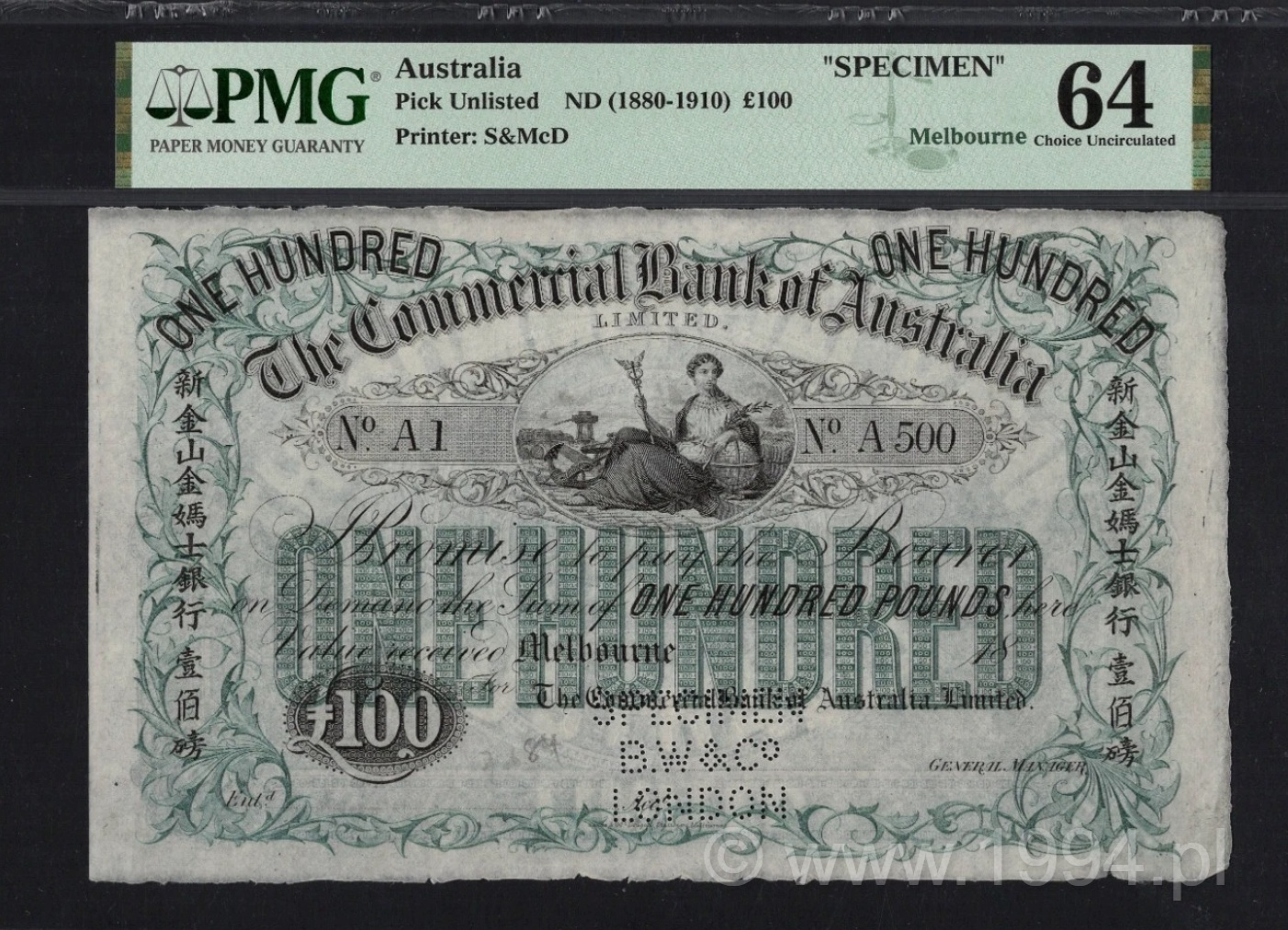
Australia 1880–1910 Commercial Bank of Australia £100 specimen, PMG 64 Choice Uncirculated

Australia 1880–1910 — Commercial Bank of Australia £100 Specimen (Pick Unlisted)

A monumental survivor from Australia’s private banking era, this £100 specimen ranks among the most important colonial-era notes known. Printed circa 1880–1910 for the Commercial Bank of Australia Limited, it represents the uppermost denomination produced under the private-issue system that existed before the Commonwealth took full control of note issuance in 1910. No issued examples of this £100 are believed to have survived, making specimens the only remaining documentation of the type. ... Read more →

AustraliaSpecimen1880100 PoundsPMG 64 Choice Uncirculated Specimen100 PoundsHigh DenominationCommercial Bank of AustraliaBradbury WilkinsonBWCSands & McDougallColonial SpecimenBilingualChinese-EnglishPick UnlistedColonial Banking HistoryAustralian Private BanknotesPre-Notes Act Era19th Century BankingMulticultural Trade NetworksSecurity Printing HistoryBritish Engraving InfluenceAustralian Monetary HistoryAustralia188019101880–1910PMG 64Museum GradeR9 Extremely RareUnique
Held
New Zealand 1907–1926 Bank of New Zealand £20 Blue audit-range serial-prefix specimen with dual control numbers, Bradbury Wilkinson & Co., PMG 55 AU, Pop 1/1, R9 Extremely Rare

New Zealand 1907–1926 — Bank of New Zealand £20 Blue Serial-Prefix Audit Specimen (Pick S194s)

A unique high-denomination Bradbury Wilkinson audit-range specimen and the rarest surviving document from New Zealand’s private-banknote era, the £20 Blue (Pick S194s) represents the apex of BNZ’s color-coded denomination hierarchy. This specimen is not a generic zero-serial example: it carries dual live serials (No. 061001 and No. ... Read more →

New ZealandSpecimen190720 PoundsPMG 55 About Uncirculated (Pop 1/1) Specimen20 PoundsBlueBNZ Color LineageHigh Denomination Color TierHigh DenominationAudit-Range SpecimenSerial PrefixDual Serial NumbersPerforated SpecimenBradbury WilkinsonBWCPick S194sBank of New ZealandPrivate Banknote EraPre-Reserve BankNew Zealand Banking HistoryBritish Engraved NotesMāori Portrait VignettesSecurity Printing HistoryHigh-Value NotesAudit Control SheetNew Zealand190719261907–1926PMG 58Pop 1Top PopMuseum GradeR9 Extremely RareUnique
Held
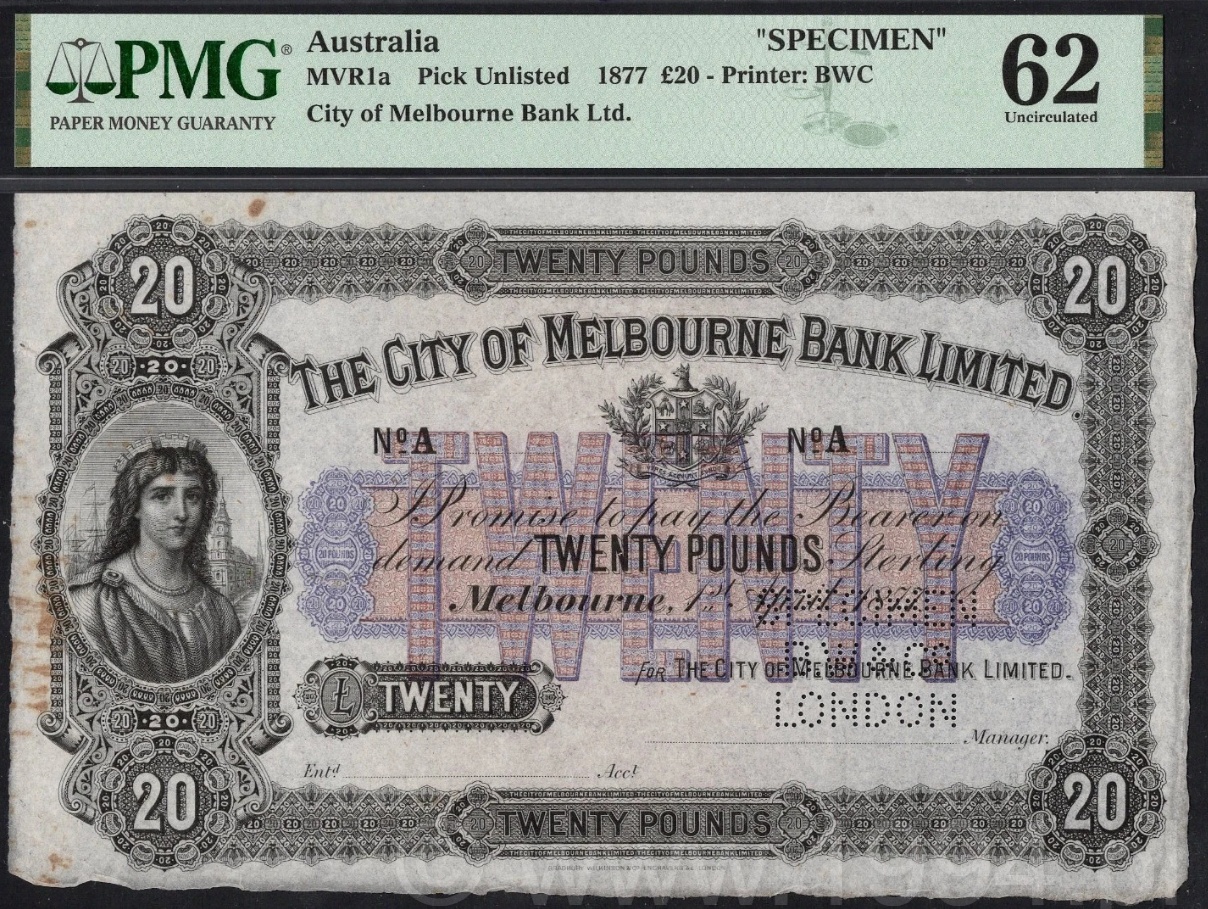
Australia 1877 City of Melbourne Bank Limited £20 specimen engraved by Bradbury Wilkinson, PMG 62 Uncirculated, unique surviving example

Australia 1877 — City of Melbourne Bank Limited £20 Specimen (Pick Unlisted)

A unique surviving specimen of the £20 denomination issued by the City of Melbourne Bank Limited, representing one of the highest-value private banknotes produced in colonial Victoria. Printed from Bradbury, Wilkinson & Co. master plates, this note belongs to the final generation of Australian private banknote engraving before national standardization and the destruction of nearly all high-denomination material. ... Read more →

AustraliaSpecimen187720 PoundsPMG 62 Uncirculated Specimen20 PoundsCity of Melbourne Bank LimitedBradbury WilkinsonBWCPick UnlistedColonial SpecimenEngraved Security PrintingAustralian Private BanknotesVictoria Banking HistoryPre-Federation FinanceGold Rush Era BankingSecurity Printing History19th Century BankingAustralian Monetary HistoryAustraliaVictoria1877PMG 62Museum GradeR9 Extremely RareUnique
Held
Australia 1877 Bradbury Wilkinson portrait of a woman intaglio vignette proof, printer’s library master engraving used for Australian private bank issues including the City of Melbourne Bank £20

Australia 1877 — Bradbury, Wilkinson & Company Portrait of Woman Intaglio Vignette Proof (Printer’s Library Master)

This intaglio vignette proof represents an original portrait engraving produced by Bradbury, Wilkinson & Company in London in 1877, prepared as a master design element within the firm’s internal plate library. It depicts a classical female figure engraved as a stand-alone vignette, intended for later integration into complete banknote layouts commissioned by private banks across the British Empire, including Australian colonial institutions. In the Bradbury Wilkinson production workflow of the late nineteenth century, portrait vignettes were engraved independently of any specific banknote. ... Read more →

AustraliaVignette1877Reference VignetteArchival Intaglio Proof Intaglio Vignette ProofEngraver’s Master PortraitPrinter’s Library ElementProduction Stage ArtifactStandalone VignetteBradbury WilkinsonBWCVictorian Era EngravingPrivate Banknote ProductionBritish Security PrintingAustraliaVictoriaPre Federation AustraliaCity of Melbourne Bank1877Twenty Pounds Design SourceMuseum GradeR9 Extremely RareUnique
Held
Brazil 1773 Tejuco Diamond Administration 6 Octavas gold receipt No. 813,

Brazil 1773 — Diamond Administration of Tejuco, 6 Octavas Gold Receipt No. 813 (Pick Unlisted)

Original 6-octava gold payment receipt (No. 813) issued on 1 December 1773 by the royal Casa da Administração Geral dos Diamantes in Tejuco (modern Diamantina, Minas Gerais). This document represents an authenticated financial transfer from the account of Ignacio Mendes de Souza, signed and validated at the highest administrative level of the Portuguese diamond district—one of the most tightly controlled economic zones in the entire Portuguese Empire. ... Read more →

BrazilFinancial Document17736 Octavas of GoldXF (Manuscript-Completed Fiscal Receipt) Financial DocumentDiamond DistrictPick unlisted1773 ReceiptNumber 8136 OctavasPortuguese Colonial BrazilCasa da Administração dos DiamantesMinas GeraisTejucoGold LedgerManuscript EntryFiscal FormRoyal Arms PortugalColonial Taxation18th Century FinancePortuguese EmpireBrazil1773R9 Extremely RareUniqueMuseum Grade
Held
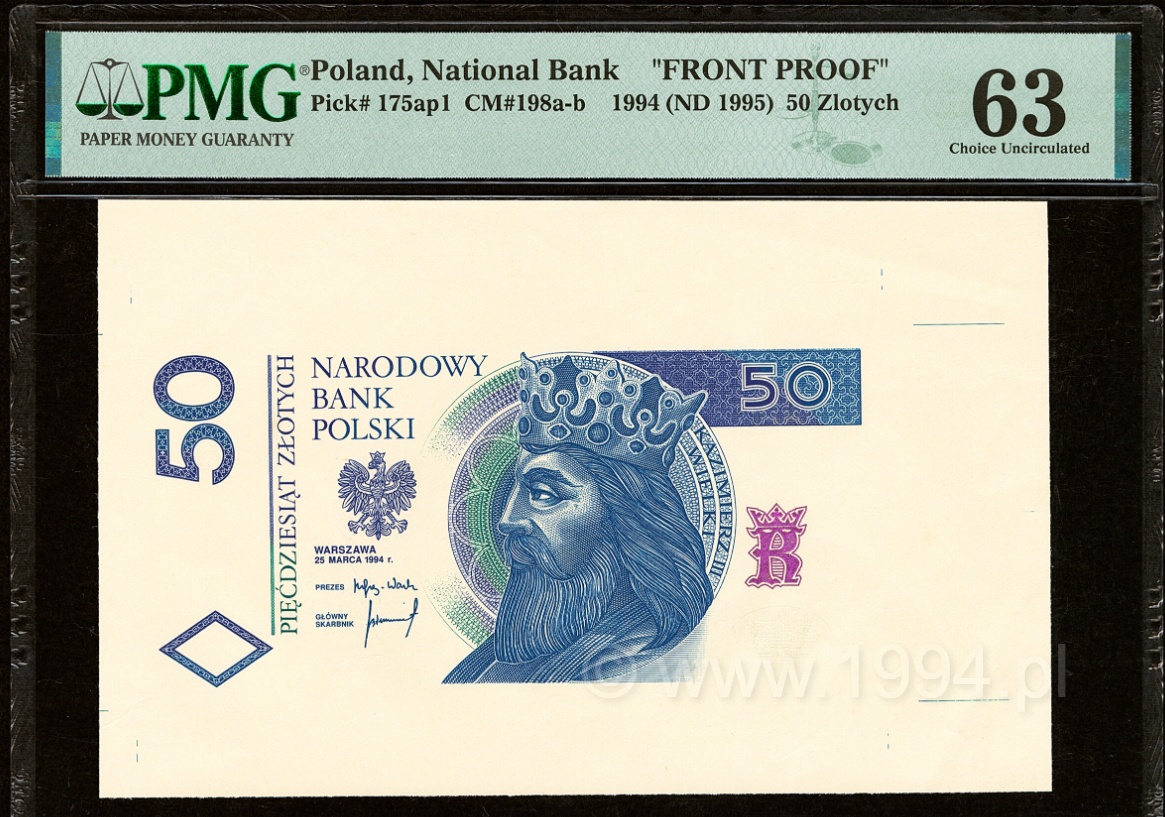
Poland 1994 50 Złotych front proof, Pick 175ap1, PMG 63 Choice Uncirculated, final approved obverse design by Thomas De La Rue

Poland 1994 — 50 Złotych Front Proof (Pick 175ap1)

The definitive front proof of the 1994 50 Złotych issue, this sheet represents the final approved obverse design prepared by Thomas De La Rue for Narodowy Bank Polski during Poland’s post-communist monetary reform. Executed as an internal production proof, it preserves the complete engraved obverse exactly as authorized for issue, prior to serial numbering and reverse printing. The design features the portrait of King Kazimierz III Wielki (Casimir the Great), rendered in De La Rue’s modern intaglio style and integrated into a complex guilloche framework reflecting European security-printing standards of the early 1990s. ... Read more →

PolandFront Proof199450 ZłotychPMG 63 Choice Uncirculated (Front Proof, Top Pop 1/1) Front ProofPick 175ap1Thomas De La RueTDLRNarodowy Bank PolskiKazimierz WielkiCasimir the GreatModern Polish BanknotesRedenomination SeriesPoland1994PMG 63Top PopR9 Extremely RareUniqueMuseum Grade
Held
Australia 1877 Mercantile Bank of Sydney £1 specimen with red ONE overprint, Pick Unlisted, printed by Bradbury Wilkinson & Co., graded PMG 66 EPQ Gem Uncirculated Pop 1, only known example

Australia 1877 — Mercantile Bank of Sydney £1 Specimen (Pick Unlisted)

A superb Bradbury, Wilkinson & Co. specimen from the early colonial banking era, this £1 note for the Mercantile Bank of Sydney survives today as the only documented example of its type. Certified PMG 66 EPQ Gem Uncirculated and recorded as Pop 1, it represents a unique surviving specimen of a private Australian bank whose issues rarely appear in any form. ... Read more →

AustraliaSpecimen18771 PoundPMG 66 EPQ Gem Uncirculated (Pop 1) Specimen1 PoundPick UnlistedRed OverprintColonial Private BankBradbury WilkinsonBWCMercantile Bank of SydneyNew South Wales Banking History19th Century FinanceAustralian Private IssuesSecurity Printing HistoryColonial PeriodAustralia1877Only Known ExampleR9 Extremely RareUniquePop 1Top PopPMG 66 EPQGem UncirculatedMuseum Grade
Held
Australia Federal Bank of Australia Limited one pound Sydney specimen printed by Bradbury Wilkinson, annotated 1882, PMG 64 Choice Uncirculated

Australia 1879–1903 — Federal Bank of Australia, Limited £1 Sydney Specimen (Pick Unlisted)

This specimen represents a one pound note prepared for the Federal Bank of Australia, Limited and printed by Bradbury, Wilkinson & Company in London during the bank’s short operational life between 1879 and 1903. The note carries the Sydney office imprint, identifying the colonial financial center where the issue was intended to circulate. It belongs to one of the most fragile and least documented chapters of Australia’s pre-Federation private banking era, when numerous colonial banks issued their own paper currency under uneven regulation and volatile economic conditions. ... Read more →

AustraliaSpecimen18791 PoundPMG 64 Choice Uncirculated (Annotated, Top Population) Specimen Banknote1 PoundPrinter SpecimenAnnotated SpecimenExport Engraved NoteLarge Format BanknoteBradbury WilkinsonBWCBritish Security PrintingVictorian Era EngravingPrivate Banknote ProductionFederal Bank of Australia LimitedAustralian Private BanksPre Federation AustraliaSydney Banking HistoryVictorian Banking Crisis1893 Banking CollapseAustraliaSydney187919031879–1903Pick UnlistedTop PopMuseum GradeR9 Extremely RareUnique
Held
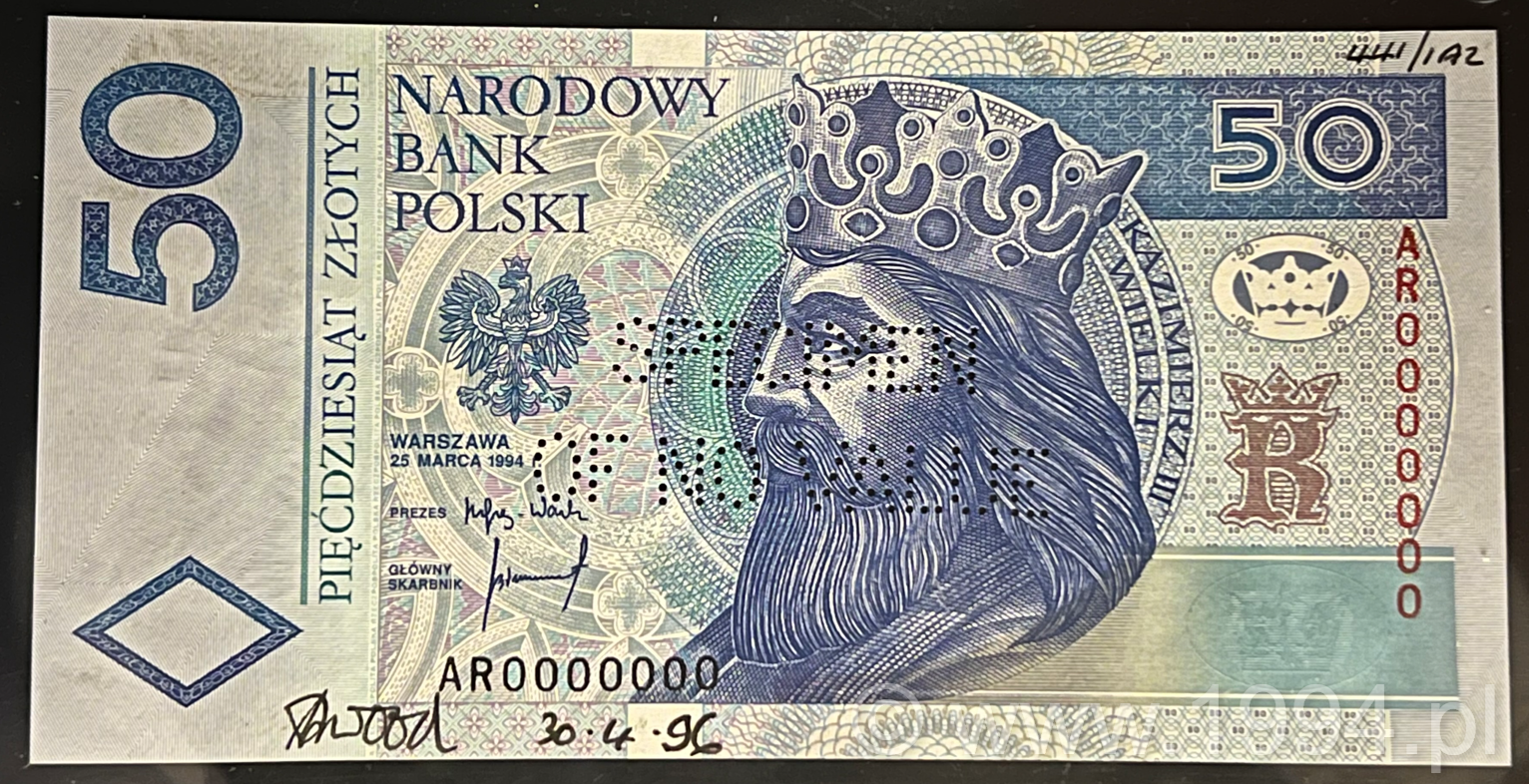
Poland 1994 50 Zlotych AR Specimen perforated SPECIMEN OF NO VALUE with handwritten archive date 30.4.96

Poland 1994, 50 Zlotych Specimen with Perforated 'SPECIMEN OF NO VALUE' AR Prefix (Pick Unlisted)

This AR-prefix specimen is a fully printed 50 zlotych banknote from Poland’s 1994 series, permanently cancelled by a large perforated inscription reading “SPECIMEN OF NO VALUE” across the portrait of King Casimir III the Great. The perforation represents a terminal archival control form prepared by Thomas De La Rue and retained for internal documentation and security reference. The banknote preserves the complete production design corresponding to the issued currency, including serial number AR0000000 and the official signatures of the National Bank of Poland. ... Read more →

PolandSpecimen Perforated 'SPECIMEN OF NO VALUE'199450 ZlotychUncirculated SpecimenApproval SpecimenPerforatedPerforated 'SPECIMEN OF NO VALUE'Printer AnnotationsUncataloguedAR PrefixSerial AR0000000Thomas De La RueTDLRMilczak UnlistedPick UnlistedThree Known Variations of 1994 Polish SpecimensPoland Currency Redesign 1994National Bank of PolandModern Polish BanknotesSecurity Printing HistoryDe La Rue Archival ControlSpecimen Control ProceduresPoland199450 ZlotychMuseum GradeR9 Extremely RareUnique
Held
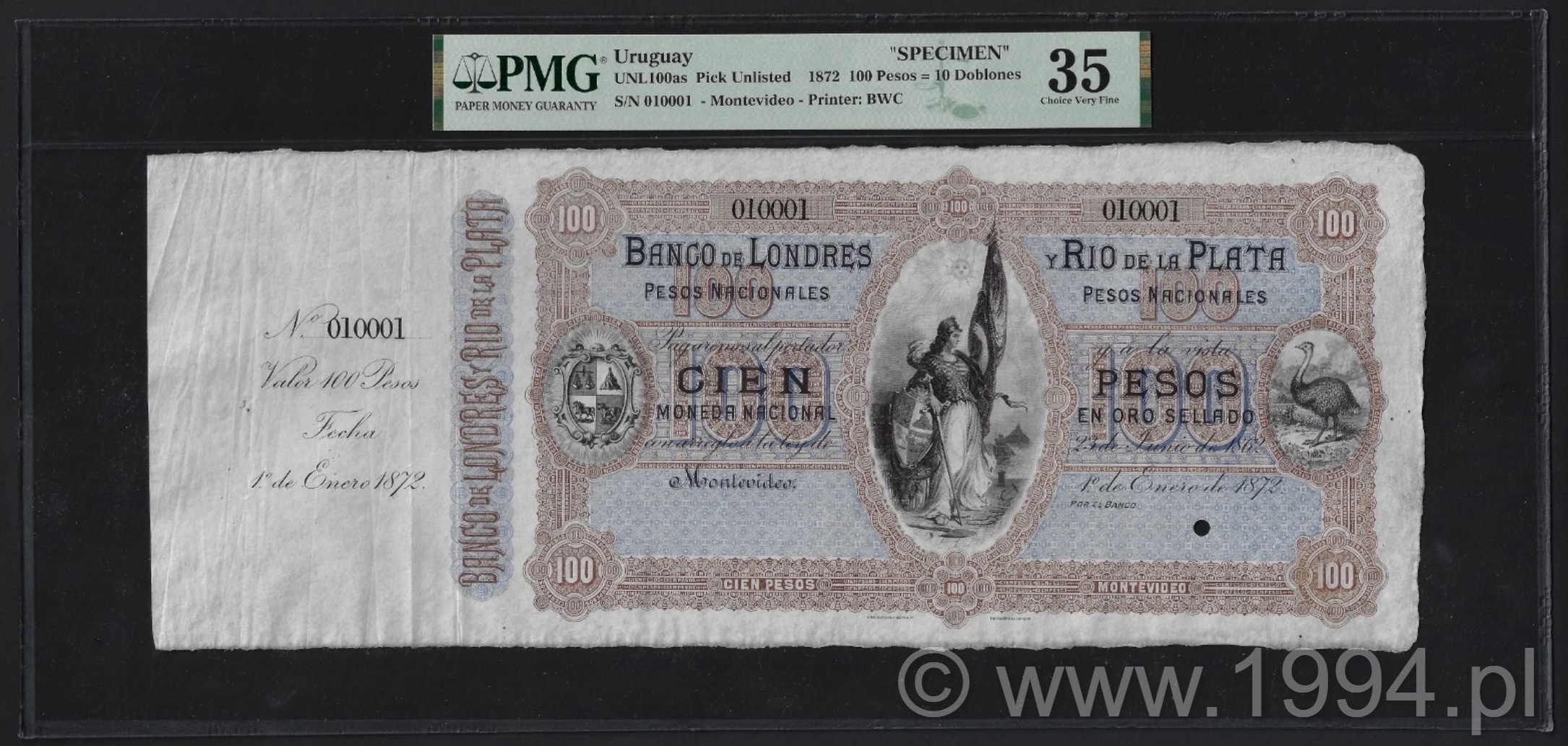
Uruguay 1872 100 Pesos equals 10 Doblones printer archival specimen, early serial number 010001, printed by Bradbury Wilkinson

Uruguay 1872 — 100 Pesos = 10 Doblones Specimen (Pick Unlisted)

A printer’s archival specimen of the 1872 issue of the Banco de Londres y Rio de la Plata, denominated 100 Pesos Nacionales with an explicit equivalence to 10 Doblones in gold. This dual-denomination construction represents one of the most ambitious monetary experiments undertaken in nineteenth-century Uruguay, attempting to anchor paper currency directly to a fixed gold value at a time of persistent instability and public distrust in fiduciary issues. The note was produced in London by Bradbury, Wilkinson & Co. ... Read more →

UruguaySpecimen1872100 Pesos = 10 DoblonesPMG 35 Choice Very Fine SpecimenPrinter Archival SpecimenDual DenominationGold EquivalenceEarly Pull Serial 010001Oversized FormatBradbury WilkinsonBWCLondon Security PrintingNineteenth Century EngravingArchival Reference NoteGold Standard ExperimentPeso Doblone ParityBanco de Londres y Rio de la PlataLatin American Monetary HistoryNineteenth Century State FinanceUruguayMontevideo1872Pick UnlistedMuseum GradeR9 Extremely RareUnique
Held
↑ Top